




1. Why choose to travel to Sa Pa by self-driving car?
Self-driving to Sa Pa offers you very unique experiences, which public transport vehicles can hardly provide. You have complete control over your time, can stop whenever you want, and change the itinerary according to the preferences of each member on the journey.
No longer restricted like when traveling by bus or train, a trip by private car allows you to stop at any desired point to capture moments, admire the scenery, or enjoy local specialties along the way. The private space in the car creates a comfortable feeling for the whole family or group of friends, allowing you to chat, listen to music, and enjoy the journey in a relaxed manner.
The road to Sa Pa is famous for its winding passes, floating clouds and mountains, and majestic scenery. When driving yourself, you can easily stop at beautiful scenic spots, visit roadside villages, or rest at small cafes. Especially, self-driving also helps you carry sufficient luggage, making it more comfortable than when traveling by bus or train.
2. Instructions for preparation before driving to Sa Pa
2.1. Vehicle checklist before the Sa Pa trip
Before each long trip, thoroughly checking the vehicle is an unmissable step. Start with the tire system, check wear, pressure, and ensure the spare tire is always ready. Next, don't forget to check the braking system, as you will frequently travel on the steep mountain passes characteristic of the Northwest region.
In addition, check the coolant, engine oil, headlights, signal lights, and wipers to ensure the car runs smoothly throughout the journey. Meticulously preparing these seemingly small details contributes to a safer and more complete trip.
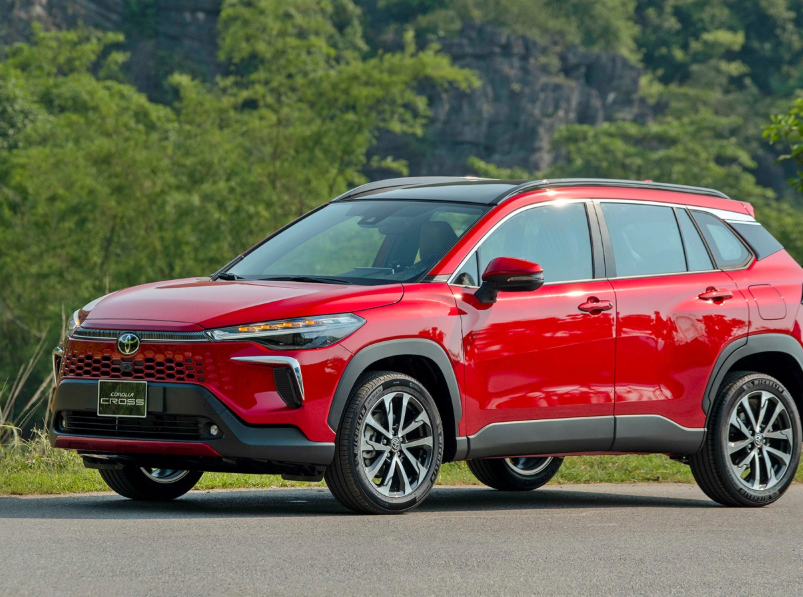
SUV (Sport Utility Vehicle) is a multi-purpose sports vehicle, characterized by high ground clearance, a sturdy, powerful, boxy design. (Source: Collected)
If possible, choose high-ground-clearance vehicles like SUVs (an abbreviation for Sport Utility Vehicle, a type of multi-purpose sports vehicle) to easily navigate steep roads or foggy, drizzly weather. Additionally, the air conditioning and heating systems need to be carefully checked, as Sa Pa's weather is often unpredictable in winter, when temperatures can drop below 5°C.
2.2. Mandatory Luggage and Items When Driving a Car to Sa Pa
A basic rescue kit is an essential item according to Sa Pa car travel experience. Besides a 12V electric pump, you should prepare a temporary tire repair kit, tow cables, and an LED flashlight in case of roadside emergencies.
Additionally, don't forget a large-capacity power bank and offline maps, as these will be particularly useful when traveling through areas with weak signal.
Personal and vehicle documents such as driver's license, registration, insurance, and citizen ID card are mandatory items to bring. Furthermore, you should also prepare some reserve cash for payments at gas stations or eateries along the way for convenience.
2.3. Useful Apps for the Trip
Navigation apps like Google Maps or Apple Maps will help you determine the quickest and most convenient route, while also making it easy to find gas stations or rest stops along the way. Besides, weather forecast apps like iPhone Weather or AccuWeather are also very important for updating good weather conditions or noting days with fog and drizzle – characteristic factors that can affect safety when traveling to Sa Pa.
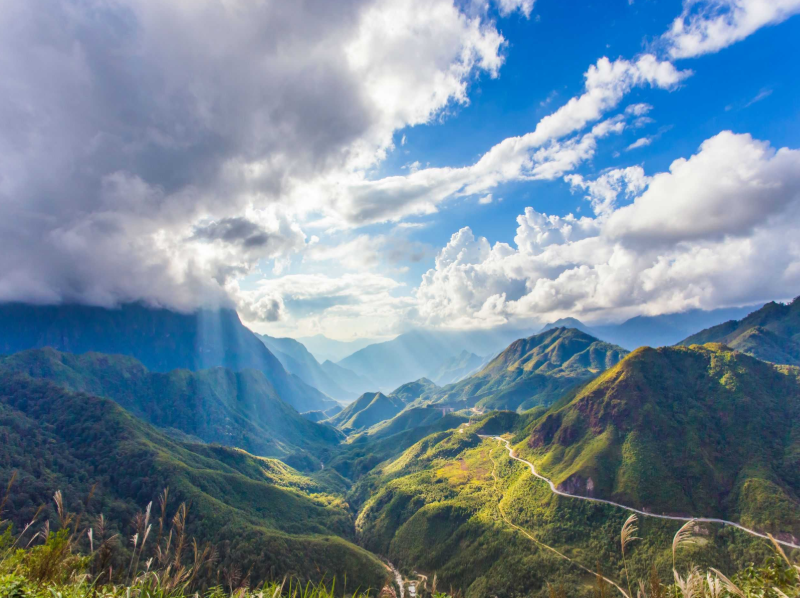
Tourists follow the Sa Pa weather forecast to proactively arrange their itinerary and fully enjoy the entertainment experiences. (Source: Collected)
To make your journey more complete, you can look up dining spots on Foody or Google Review. These are reliable platforms that help you easily find delicious, convenient eateries highly rated by many tourists.
Additionally, don't forget to download an offline map of the Lao Cai - Sa Pa area to be more proactive when losing connection. Saving the contact information of your pre-booked hotel, restaurant, or accommodation in your phone's notes will help you save time and feel more secure throughout your journey.
3. Detailed Itinerary to Sa Pa by Car
3.1. Hanoi - Lao Cai Expressway
The Hanoi - Sa Pa route is currently the top choice for tourists due to its convenience and significantly reduced travel time. From Hanoi, you travel across Nhat Tan Bridge, turn onto Vinh Phuc road to merge onto the Noi Bai - Lao Cai expressway, which is about 300 km long. Upon reaching Lao Cai city, continue on National Highway 4D for another approximately 38 km to reach the center of Sa Pa town.
The total distance is about 320 km, with an average travel time of 5-6 hours, depending on traffic conditions. Many experienced tourists recommend departing early in the morning to enjoy the fresh air, avoid traffic jams, and have more time for breaks along the way.
The Noi Bai - Lao Cai expressway is quite modern and safe, with a dense system of speed monitoring cameras, especially in sections belonging to Vinh Phuc and Phu Tho. The toll fee ranges from 20,000 to 600,000 VND per trip, depending on the vehicle type.
Upon arriving in Lao Cai, you can stop for a rest, have lunch, or wander around Coc Leu market, Lao Cai international border gate before continuing your journey. The section from Lao Cai to Sa Pa is about 30-38 km long, winding along the mountainside with many curves and steep slopes, so be mindful to drive slowly and keep a firm grip on the steering wheel.
Thanks to the road infrastructure being expanded 2-3 times larger than before, driving to Sa Pa is now easier and safer, opening up a more complete journey to conquer the Northwest mountains.
3.2. National Highway 32
National Highway 32 is suitable for those who love personal experiences and have extensive experience driving on mountain passes. The route travels through landmarks such as Hanoi - Son Tay - Phu Tho - Yen Bai - Lai Chau - Sa Pa, with a total length of about 400 km. Although the distance is longer, taking 7 to 8 hours, driving to Sa Pa on this route will take you through pristine mountains, valleys, rich ethnic villages, and prominent terraced fields.
This route has many winding and steep passes, and the road surface is narrower than the expressway. You will cross famous passes like Pha Din, and cities like Yen Bai with its characteristic market, and the airy Lai Chau with its green rice fields. Before choosing this route, you should prepare both physically and with good driving skills, as the terrain is complex and the weather can change unexpectedly.
4. Attractive Check-in Spots in Sa Pa
4.1. Sun Plaza - The Symbol in the Heart of Sa Pa Town
Located right in the center of town, Sun Plaza has long been a prominent architectural symbol of Sa Pa, a destination that every tourist wants to visit at least once. The structure bears a strong resemblance to classic European style, with its characteristic blue-yellow color scheme and intricate domes, creating a luxurious and romantic beauty amidst the misty clouds of the Northwest mountains.
Not only is it an ideal place for check-ins and souvenir photos, but Sun Plaza is also considered the "heart of Sa Pa," the starting point for all exploration journeys. From here, tourists can easily reach the Stone Church of Sa Pa with just a few minutes' walk, or begin their journey to conquer Fansipan - the roof of Indochina - via the cable car station of Sun World Fansipan Legend located within the building.
A big plus for Sun Plaza is its spacious and safe parking area, which is very convenient for those traveling by private car. Stopping here, tourists can not only admire a structure with a Western flair amidst the Vietnamese mountains but also feel the harmony between modernity and heritage, between romantic beauty and sophistication, a distinctive mark in Sa Pa.

Sun Plaza Sa Pa - a miniature corner of Europe in the misty town. (Source: Collected)
4.2. Cat Cat Village - The simple beauty of the Hmong ethnic village
Located about 4 km from the center of Sa Pa, Cat Cat Village is an unmissable destination for those who love local culture and wild nature. The road into the village is lined with flowers and small streams winding through the mountains and forests, creating a poetic scene.
Visitors can easily travel by car , as the road is wide, flat, and has convenient parking. Here, you will admire traditional wooden houses, visit the handicraft linen weaving craft, and capture countless impressive photos amidst the peaceful village scenery.
4.3. Silver Waterfall - Majestic beauty amidst the wilderness
About 12 km from the center of Sa Pa along National Highway 4D, Silver Waterfall is one of the famous scenic spots in the Northwest region. The waterfall, over 200 m high, cascades down from the mountain peak, creating a white water curtain with a beauty that is both majestic and poetic.
The road to Silver Waterfall is quite convenient for cars, with many beautiful viewpoints. It is also an ideal place to rest, breathe in the fresh air, and enjoy the murmuring sounds of nature amidst the mountains and forests.
4.4. Ta Phin Village - Colors of culture and peaceful nature
Located to the east of Sa Pa, about 12 km from the town center, Ta Phin Village attracts tourists with its vast green terraced fields and the cultural beauty of the Red Dao people.
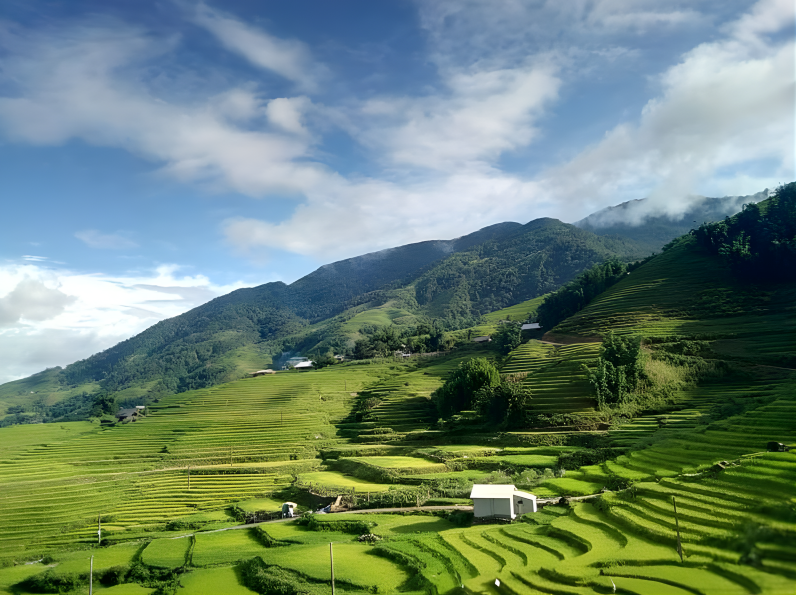
Ta Phin village attracts tourists with its vast, lush green terraced fields. (Source: Collected)
Here, you can experience traditional herbal bath services, learn about the local customs and way of life, or simply admire the mountains and forests in the misty haze. The journey to Ta Phin is rated by many tourists as providing a relaxing experience and a full appreciation of the simple, authentic beauty of Sa Pa.
5. Experience driving a car to Sa Pa safely
5.1. Tips for driving safely on the Lao Cai - Sa Pa mountain pass
The route from Lao Cai to Sa Pa is one of the famous mountain passes in the Northwest region, with many hairpin bends and steep inclines. Therefore, mastering driving techniques is crucial for ensuring safety on the journey.
Safe uphill driving techniques
When preparing for an uphill section, drivers should gently and steadily accelerate before reaching the foot of the slope. This helps build momentum for the car to climb smoothly without needing to press the accelerator hard. However, you need to maintain a stable speed, avoiding sudden acceleration, especially in slippery conditions or fog, to minimize the risk of skidding.
As the car approaches the uphill section, gently release the accelerator, press the clutch, and shift down to a lower gear if using a manual transmission. Observing the engine RPM is very important to ensure the speed and gear are compatible, providing strong and stable traction throughout the climb.
After shifting to a lower gear, you should release the clutch slowly and apply the accelerator evenly. This technique helps maintain a stable engine RPM, avoids jerky movements on long uphill climbs, and improves tire grip, especially at "hairpin bends" (sharp and treacherous turns on mountain roads).
Depending on the steepness of the road, drivers can choose first or second gear to ensure sufficient traction. For gentle slopes, third gear is a more suitable choice. When accelerating uphill, release the clutch slowly and apply more throttle than usual to overcome the slope smoothly, preventing the vehicle from rolling backward.
In case the car loses power or struggles to climb, you should press the clutch, shift to a lower gear, and gently increase the throttle to regain momentum and avoid overloading or stalling. For automatic transmission cars, climbing hills is simpler. Drivers just need to shift the gear lever to D1 or D2 to maintain stable traction, allowing the car to easily overcome steep sections while ensuring safety and a smooth ride.
Safe downhill driving techniques
When driving on steep mountain passes from Lao Cai to Sa Pa, mastering downhill driving techniques is essential for safety. Drivers should shift to a lower gear such as L, D2, or M to utilize engine braking. This method helps the car slow down naturally, reduces reliance on the brakes, and minimizes the risk of brake overheating on long descents.
When going downhill, you should keep your foot near the brake pedal, ready to use it, but avoid continuous braking. Prolonged braking can cause the brakes to overheat, reducing their effectiveness and posing a danger. Instead, brake intermittently and gently, especially when you feel the car accelerating rapidly. If necessary, you can shift to a lower gear to reduce speed without excessive wear on the braking system.
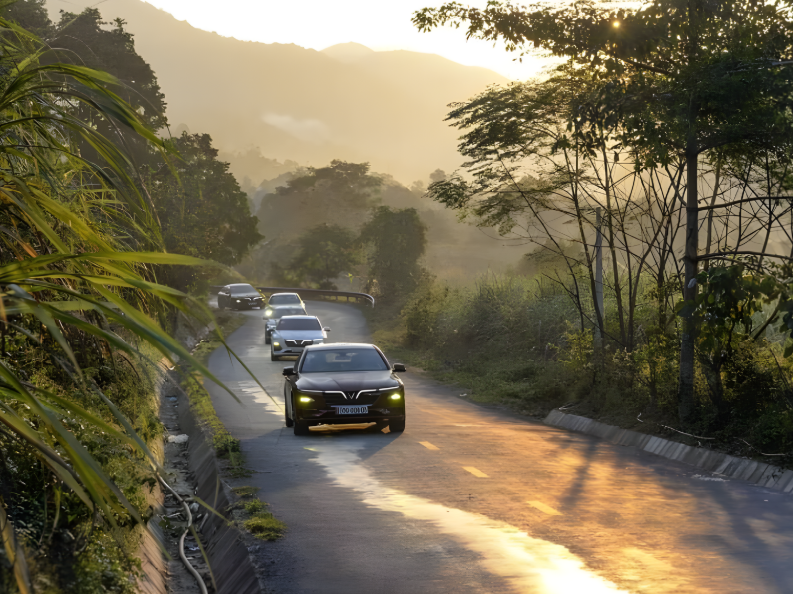
Throughout the journey, visitors should pay attention to the rearview mirror to avoid collisions with surrounding vehicles. (Source: Collected)
At sharp turns, slow down before entering the turn and absolutely do not brake suddenly while cornering. Hugging the inside slightly helps widen your field of vision, keep the vehicle stable, and easily handle oncoming traffic.
Additionally, you should maintain a safe distance of 50 - 70 m from the vehicle in front, especially when following trucks or containers, as these vehicles often move slowly and may stop suddenly on steep inclines. Throughout the journey, frequently check your rearview mirror to promptly detect small vehicles like motorbikes or cars that may unexpectedly appear in your blind spot.
5.2. Handling fog, drizzle, or traffic jams
Fog is a common weather factor that greatly affects the application of safe driving experience for Sa Pa. When driving in dense fog, turn on your low beam headlights, fog lights, and hazard lights. Slow down, drive close to the right edge of the road to allow other vehicles to pass. Do not stop in the middle of the road or on a narrow shoulder; instead, find safe areas like gas stations or well-lit places to wait.
In case of drizzle, the road surface may be slippery, so increase the distance from the vehicle in front and avoid sudden braking. Always keep drinking water, snacks, and a light blanket in the car to be prepared when waiting in cold weather.
5.3. Dangerous traffic violations to strictly avoid
A common mistake to avoid according to Sa Pa driving experience is descending a pass in a high gear, as this makes the vehicle difficult to control speed and risks not being able to brake in time. Visitors should use a low gear, combined with appropriate use of the foot brake to ensure a stable speed when going downhill.
Do not follow closely behind large vehicles like trucks or containers, as your visibility will be limited and it will be difficult to anticipate the situation ahead. Maintain a safe distance and patiently wait for a straight, wide section of road to overtake.
In addition, visitors should also be careful to avoid crossing lanes or overtaking at curves or in areas with poor visibility, as the risk of collision with oncoming vehicles is very high. When traveling on mountain roads, always prioritize safety over trying to shorten travel time.
Driving to Sa Pa by self-drive car offers a proactive, economical, and emotionally rich journey for every trip. With thorough preparation in all aspects, adherence to safety principles, and a reasonable spending plan, your exploration of Sa Pa will surely be complete. Start planning your trip to Sa Pa and share memorable moments in this misty mountain region!


